Home Contact Us Search Recent Additions Receive
Publications
Site Map

A A ATEXT SIZE  


RTC:RURAl

Ruralfacts

Update on the Demography of Rural Disability Part One: Rural and Urban

Research and Training Center on Disability in Rural Communities, The University of Montana Rural Institute

April 2005


How many people with disabilities live in rural America?  
It depends on how you define "rural" and "disability". *

Defining Rural:

The 2005 Merriam-Webster Dictionary simply defines rural as "of or relating to the country, country people or life, or agriculture." Most people have an idea of what makes an area rural, but the perception of ruralness may not always match the specific definitions used by agencies responsible for counting, analyzing, or distributing community resources.

It's common to use counties as the measurement unit. Counties are categorized as metropolitan or non-metropolitan, with the non-metropolitan counties considered rural. (See Update on the Demography of Rural Disability, Part Two: Non-Metropolitan and Metropolitan for more information.)

However, "rural" and "urban" areas are not geographically tied to counties and may cross county or state lines. These areas are measured by population density. While not accounting for economic diversity, this approach more accurately reflects the aerial view of a settled area's density. To understand rural America in this context, it is important to define four key U.S. Census terms: urban, urbanized area, urban cluster, and rural areas.

Urban: Territory, population and housing units located within urbanized areas and urban clusters.

Urbanized area: A densely-settled area with a Census population of at least 50,000. A typical urbanized area has more than 500 people per square mile and consists of all or part of one or more incorporated places, such as towns.

Urban cluster: A densely settled area with a census population of 2,500 to 49,999.

Rural areas: Territory, population, and housing units located outside of urbanized areas or urban clusters. Rural areas have fewer than 2,500 people or areas where people live in open country.

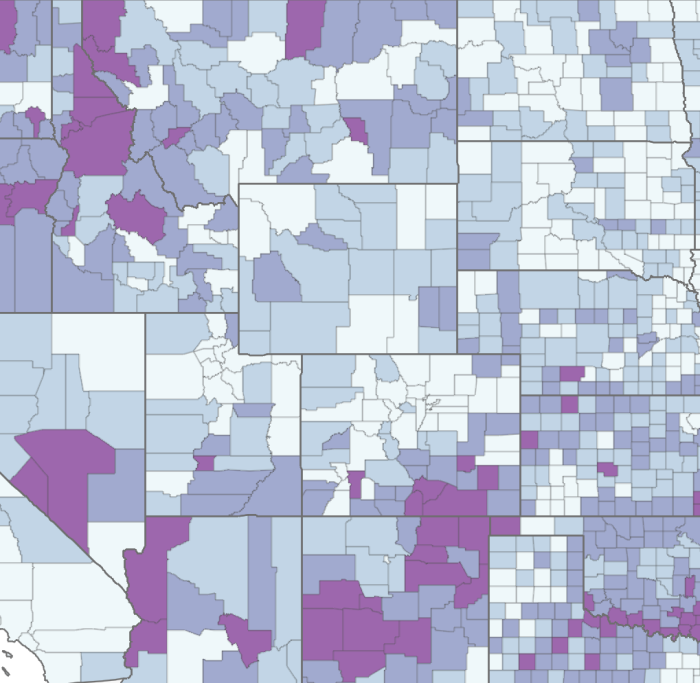
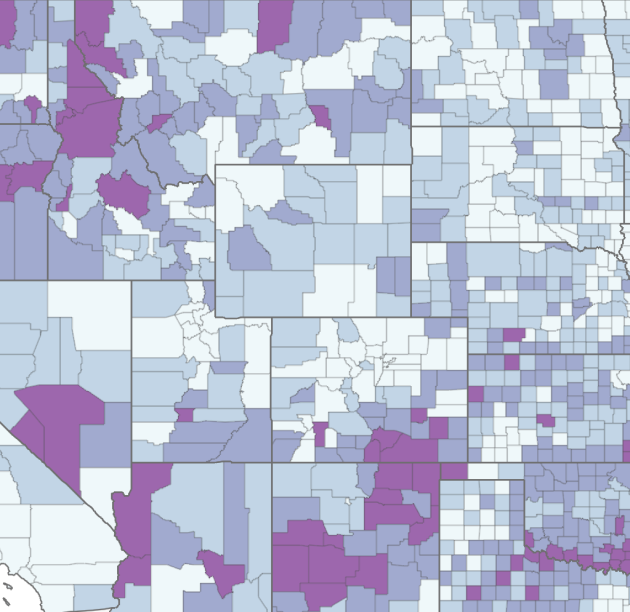
The map shows the locations of U.S. urbanized areas (blue) and urban clusters (green). Rural areas are shown in gray and represent 97 percent of U.S. land mass. Urbanized areas and urban clusters comprise the remaining three percent. Note: Rural data for U.S. counties are accessible at http://rtc.ruralinstitute.umt.edu/geography .

Where Do Rural People with Disabilities Live? 
Description of map
.

For more detail, go to http://rtc.ruralinstitute.umt.edu/geography/counties.htm Population Distribution by Urbanized Areas and Urban Clusters


Rural America: 3,444,930 square miles; more than 97% of the total U.S. land mass; 21% of the total U.S. population; 59,061,367 people of whom 10,852,330 have a disability.

Urban Clusters: 20,485 square miles; almost 1% of the total U.S. land mass; 11% of the total U.S. population; 30,036,715 people of whom 5,691,886 have a disability.

Urbanized Areas: 72,021 square miles; 2% of the total U.S. land mass; 68% of the total U.S. population; 192,323,824 people of whom 33,202,032 have a disability.

Map Data Source: American Fact Finder Summary Files 1 & 3. Census 2000 DVD Summary File 1, and 2000 TIGER Cartographic Boundary Files.


Disability:As does rural, "disability" has many definitions. The 2000 U.S. Census classified a person as having a disability if any of the following conditions were true: 1. A person aged five or older reported a long-lasting sensory, physical, mental or self-care disability; 2. A person aged 16 or older reported difficulty going outside the home because of a physical, mental, or emotional condition lasting six months or more; or 3. A person aged 16 to 64 reported difficulty working at a job or business because of a physical, mental, or emotional condition lasting six months or more. For more information, see Census Brief: Disability Status 2000 in the Resources section.

Annual federal data are available for certain county social and economic characteristics. Only the decennial Census, however, currently provides data on the characteristics of urban and rural residents. The annual American Community Survey currently provides data about cities and counties with large populations, and updated data on rural areas and low-population counties should be available in 2010 when the Survey reports its first data on rural America.

The 2000 Census collected disability information only from people aged five and older in the civilian, non-institutionalized population. Disability status was not asked of individuals in institutions or people in the Armed Forces. The percentage of people with disabilities is calculated by dividing the number of persons with a disability by the number of civilian, non-institutionalized persons aged five or older.

Table 1 shows the 2000 Census distribution of people across urban and rural classifications. 10.8 million (19.9%) of the almost 55 million rural Americans aged five or older have a disability. The highest proportion of the population with a disability lives in urban clusters. It may be that a rural individual who acquires a disability or a family with a school-aged child with a disability "moves to town" (an urban cluster) rather than moving to a city. Description of Table 1.

Table 1: Disability Demographics in Urban and Rural America

Civilian, non-institutionalized population, 5 years and older


Total population

Total number

Number with a disability

Percent with a disability

United States

281,421,906

257,167,527

49,746,248

19.3%

Urban

222,360,539

202,525,481

38,893,918

19.2%

Urbanized areas

192,323,824

175,830,154

33,202,032

18.9%

Urban clusters

30,036,715

26,695,327

5,691,886

21.3%

Rural

59,061,367

54,642,046

10,852,330

19.9%

Rural Transit (Rural + Urban Clusters)*

89,098,082

81,337,373

16,544,216

20.3%

Another Way to Look at Rural:

There are other ways to categorize rural population density. For example, rural transportation planners and providers create a unique definition using these categories. Because transportation programs usually do not include urban clusters in their urban measurement, "rural" effectively becomes "rural plus urban clusters." * (See Frequently Asked Questions: Applying 2000 Census Data to Urbanized and Urban Areas.) By this estimate there are about 89 million residents living in rural transportation areas, 16.5 million of whom have a disability.

Figure 2. U.S. Population: Urban/Rural Bar Graph

Figure 2. Is Rural America's Population Declining?

The proportion of the American population living in rural areas has declined, but the absolute number has remained fairly stable.

Figure 2 shows that the number of rural residents has increased modestly over the past 50 years. However, the number of people living in urban areas has more than doubled. 

Description of Figure 2.

*How many people with disabilities live in rural America? Based on our analysis of Census 2000 data, more than 10.8 million rural Americans report experiencing disability.


References & Resources

Bureau of the Census (2002). Urban area criteria for Census 2000. Federal Register, 67, 51. Pages 11663-11670.

Bureau of the Census (2004). Census 2000 Urban and Rural Classification. Washington, DC: Economics and Statistics Administration. http://www.census.gov/geo/www/ua/ua_2k.html 

Bureau of the Census. (2005). Decennial Management Division Glossary. Washington, DC: Economics and Statistics Administration. http://www.census.gov/dmd/www/glossary.html 

Economic Research Service (2003). Measuring Rurality. Washington, DC: United States Department of Agriculture. http://www.ers.usda.gov/Briefing/Rurality/WhatisRural/

Frontier Education Center: National Clearinghouse for Frontier Communities. http://www.frontierus.org/ 

Merriam-Webster, Inc. (2005). Merriam-Webster Online Dictionary. Merriam-Webster, Inc.: Springfield, MA. http://www.m-w.com

Tarmann, A. (2003). Fifty Years of Demographic Change in Rural America. Washington, DC: Population Reference Bureau. http://www.prb.org/rfdcenter/50yearsofchange.htm

Federal Highway Administration. (2003). Frequently Asked Questions: Applying 2000 Census Data to Urbanized and Urban Areas, March 31, 2003 Version. Washington, DC: U.S. Department of Transportation. http://www.fhwa.dot.gov/planning/census/faqa2cdt.htm .

Waldrop, J. & Stern, S. (2003). Census Brief: Disability Status 2000. Washington, DC: U.S. Census Bureau. http://www.census.gov/prod/2003pubs/c2kbr-17.pdf . For text version of pdf file: Go to http://rtc.ruralinstitute.umt.edu/CIL/people.html , scroll down past the maps and choose Disability Status 2000.


For more information, contact:

Alexandra Enders 
Research and Training Center on Disability in Rural Communities
The University of Montana Rural Institute: A Center for Excellence in Disability Research, Education and Service, 52 Corbin Hall, Missoula, MT 59812-7056
email the Rural Institute   Web Site: http://rtc.ruralinstitute.umt.edu
888-268-2743 toll-free,    406-243-5467 Voice,    406-243-4200 TTY,    406-243-2349 (fax)

This research is supported by grant #H133B70017-01 from the National Institute on Disability and Rehabilitation Research, U.S. Department of Education. The opinions expressed reflect those of the authors and are not necessarily those of the Department of Education.

This factsheet was prepared by Tom Seekins and Alexandra Enders, RTC: Rural 2005. It is also available in large print, Braille, and as a text file on disk.  Alternative format of the data represented on the map is at http://rtc.ruralinstitute.umt.edu/geography/ . The Ruralfacts Series is edited by Diana Spas.

Questions? Would you like to receive periodic updates about our research and training activities? Do you have comments or suggestions about this site? E-mail your requests, comments and suggestions to Diana Spas or call 888-268-2743 and ask for the Information Coordinator.


NIDR Logo