![]() |
Update on the
Demography of Rural Disability
Part Two:
|
||||||||||||||||||||||||||||||||||||||||||||||||||||||||||||||||||||||||||||||
|
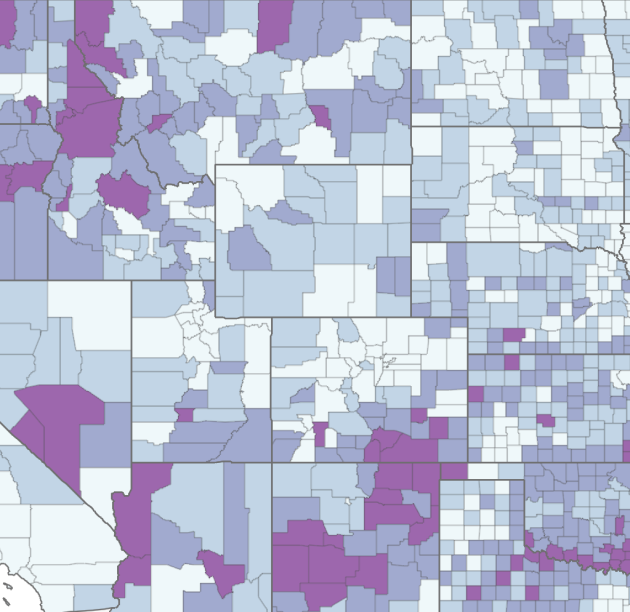
Based on our research, only 35 U.S.
counties have no rural people with disabilities, Why Does This Matter to Rural Americans with Disabilities? Resource distribution and access to services are affected by how people and counties are counted and classified. "Non-metropolitan" counties are frequently treated as being synonymous with "rural"; and if a county is designated as "metropolitan", all territory or people within it are also presumed to be metropolitan. In reality however, many rural areas are located within metropolitan counties. Data from Census 2000 showed that for the first time over half of all rural Americans live in counties designated as metropolitan. The nation - 2,052 non-metropolitan counties occupy 97 percent of U.S. land area, and are home to about one-fifth (almost 44.5 million) of the U.S. population. Approximately 22 percent (9.7 million) of these non-metropolitan Americans have a disability. Research shows that people with disabilities living in non-metropolitan counties experience social, health, economic, and educational disadvantages equal to or greater than their central city counterparts (Norton & McManus, 1989; Swanson, 1990). Non-metropolitan counties have the highest poverty rates (Rojewski, 1992; Nord, 1997). Of the 386 counties categorized as "persistent poverty" counties, 340 are non-metropolitan counties (USDA Economic Research Service, 2004). DefinitionsMetropolitan county: A central county with (1) one or more urbanized areas each having a population of 50,000 or more residents, plus (2) any outlying counties in which at least 25 percent of the working age population commute to the central county for work or in which 25 percent of the outlying county's workers commute from the central county - the so-called "reverse" commuting pattern. Non-metropolitan county: Classified as either a "non-metropolitan, micropolitan" or "non-metropolitan, non-core" county. Non-metropolitan, micropolitan counties have one or more urban clusters (towns) of 10,000 to 49,999 persons. As with metropolitan counties, a micropolitan area can have one or more counties, and outlying counties are affected by commuting patterns. Non-metropolitan, non-core counties contain no town (urban cluster) of at least 10,000 people. (Office of Management & Budget, Census 2000, http://www.ers.usda.gov/Briefing/Rurality/Newdefinitions/ ). Census 2000 collected disability information only from people aged five and older in the civilian, non-institutionalized population. Disability status was not asked of individuals in institutions or people in the Armed Forces. The percentage of people with disabilities is calculated by dividing the number of persons with a disability by the number of civilian, non-institutionalized persons aged five or older. Table 1 shows the population breakdown by metropolitan and non-metropolitan county designation. We know that many rural Americans actually live in metropolitan counties, so it's also important to look at disability and county classifications from a rural perspective. Table 2 provides figures only for the rural population. Table 1 shows 9,654,261 non-metropolitan people with disabilities. Table 2 shows 10,852,330 rural people with disabilities. This difference doesn't seem very large, until you realize they are not the same 10-11 million people. Focusing rural attention only on non-metropolitan counties overlooks the almost half of rural Americans with disabilities who live in metropolitan counties. However the "rural" category does not include the 5 million people with disabilities in urban clusters - towns with 2,500 - 49,999 people. Table 1: Disability Demographics for U.S. Metropolitan and Non-metropolitan Counties
Note: American Fact Finder currently only has Census 2000 data available for Metropolitan Statistical Areas using the older Census Glossary definitions. For more information on the 1993-2003 changes in county metro and non-metro status, see http://www.ers.usda.gov/Briefing/Rurality/Newdefinitions/ Table 2. U.S. Rural Disability Demographics
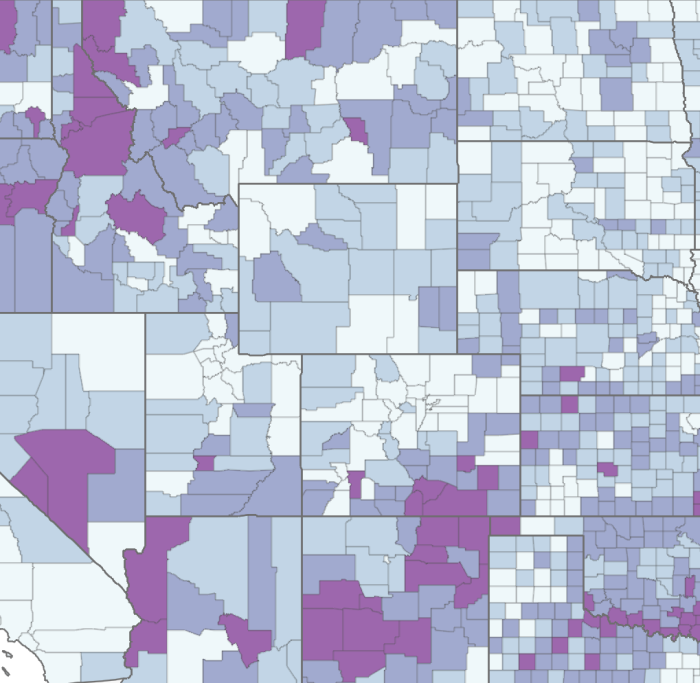
Source: Census 2000, American Fact Finder, Summary File 1. Census 2000 DVD: Summary File 3. Other approaches may better reflect where people live, and the implications that residence and population density have for service needs. For example, rural transportation planners do not include people living in non-metropolitan urban clusters as "urban". Using transportation classifications, there are about 89 million residents living in rural transportation areas, 16.5 million of whom have a disability (i.e, they count all of the people in non-metropolitan counties, plus the rural people living in metropolitan counties.) So why are non-metropolitan counties still equated with rural, and metropolitan counties equated with non-rural? It's because a county is a basic governmental administrative unit and agencies responsible for counting, analyzing, or distributing resources typically rely on a county's metropolitan or non-metropolitan designation. A county perspective is also valuable because some federal data on county social and economic characteristics are updated at least annually. Data based on population density (i.e. rural) has only been available every ten years from the decennial Census. Map 1 shows U.S. counties in metropolitan statistical areas; non-metropolitan, micropolitan statistical areas; and non-metropolitan, non-core areas. Data for U.S. counties is accessible online at http://rtc.ruralinstitute.umt.edu/geography/counties.htm Map 1. Rural America:
Where Rural = Non Metropolitan Counties Description of Map 1.
Non-metropolitan, non-core counties: Have no urban cluster of at least 10,000 people (1,360 counties; 1,907,653 square miles; 19,364,164 people of whom 4,028,333 have a disability). Non-metropolitan, micropolitan statistical area counties: Have at least one urban cluster of 10,000 to 49,999 people (692 counties; 732,712 square miles; 29,477,802 people of whom 5,625,928 have a disability). Metropolitan statistical area counties: Have at least one urbanized area of 50,000 or more people (1,089 counties; 897,095 square miles; 232,579,940 people of whom 40,091,987 have a disability). Map Data Source: American Factfinder Summary Files 1 & 3; Census 2000 TIGER Cartographic Boundary Files; Census 2000 DVD Summary File 1; OMB 11/2004 Metropolitan and Micropolitan Statistical Area Definitions, http://www.census.gov/population/www/metroareas/metrodef.html Map 2 shows the locations of urbanized areas (blue) and urban clusters (green). Rural areas are shown in gray and represent 97% of U.S. land mass. Urbanized areas and urban clusters make up the remaining 3%. Rural data for U.S. counties is accessible at: http://rtc.ruralinstitute.umt.edu/geography/counties.htm Map 2. Rural America, based on Population Density, covers 97% of the U. S. Landscape Rural America: 3,444,930 square miles; more than 97% of the total U.S. land mass; 21% of the total U.S. population; 59,061,367 people of whom 10,852,330 have a disability. Urban Clusters: 20,485 square miles; almost 1% of the total U.S. land mass; 11% of the total U.S. population; 30,036,715 people of whom 5,691,886 have a disability. Urbanized Areas : 72,021 square miles; 2% of the total U.S. land mass; 68% of the total U.S. population; 192,323,824 people of whom 33,202,032 have a disability. Map Data Source:American Fact Finder Summary Files 1 & 3. Census 2000 DVD Summary File 1, and 2000 TIGER Cartographic Boundary Files. Disability: Census 2000 classified a person as having a disability if any of the following conditions were true: 1. A person aged five or older reported a long-lasting sensory, physical, mental or self-care disability; 2. A person aged 16 or older reported difficulty going outside the home because of a physical, mental, or emotional condition lasting six months or more; or 3. A person aged 16 to 64 reported difficulty working at a job or business because of a physical, mental, or emotional condition lasting six months or more. For more information, see Resources/References for Census Brief: Disability Status 2000. Definitions Drive Resource Distribution Why the Office of Management and Budget (OMB) says it matters: ..."Metropolitan and Micropolitan Statistical Areas - collectively called Core Based Statistical Areas (CBSAs) - should not serve as a general purpose geographic framework for nonstatistical activities and may or may not be suitable for use in program funding formulas. The Metropolitan and Micropolitan Statistical Area Standards do not equate to an urban-rural classification; all counties included in Metropolitan and Micropolitan Statistical Areas and many other counties contain both urban and rural territory and populations. Programs that base funding levels or eligibility on whether a county is included in a Metropolitan and Micropolitan Statistical Area may not accurately address issues or problems faced by local populations, organizations, institutions, or governmental units. For instance, programs that seek to strengthen rural economies by focusing solely on counties located outside Metropolitan Statistical Areas could ignore a predominantly rural county that is included in a Metropolitan Statistical Area because a high percentage of the county's residents commute to urban centers for work. Although the inclusion of such a county in a Metropolitan Statistical Area indicates the existence of economic ties, as measured by commuting, with the central counties of the Metropolitan Statistical Area, it may also indicate a need to provide programs that would strengthen the county's rural economy so that workers are not compelled to leave the county in search of jobs...." Federal Register, Vol. 65, No. 249, pages 82228-82229, 12/27/2000. References & Resources:
California Rural Health Policy Council, Sacramento, CA:
Christman, J. Scott, (2004) Urban and Rural Designations: Impact on Rural
Healthcare in California http://www.ruralhealth.ca.gov/pdf/Urban_Rural_Issue_Paper.pdf
Government Accountability Office (2004) Rural Housing: Changing the Definition
of Rural Could Improve Eligibility Determinations, publication number:
GAO-05-110 http://www.gao.gov/new.items/d05110.pdf For additional reading:Ruralfacts: Update on the Demography of Rural Disability: Part One, Rural and Urban, 2005 PDF File For more information, contact: This factsheet was written by Tom Seekins and Alexandra Enders; maps created by Zach Brandt, RTC: Rural 2005. It is also available in large print, Braille, and as a text file on disk. Alternative format of the data represented on the map is at http://rtc.ruralinstitute.umt.edu/geography/ . The Ruralfacts Series is edited by Diana Spas. Questions? Would you like to receive periodic updates about our research and training activities? Do you have comments or suggestions about this site? E-mail your requests, comments and suggestions to Diana Spas or call 888-268-2743 and ask for the Information Coordinator. |
|||||||||||||||||||||||||||||||||||||||||||||||||||||||||||||||||||||||||||||||